Why should we worry about Zika virus?
The mosquito borne virus Zika Vius has been linked to over 4000 babies born with serious tragic brain deformities , such as microcephaly, a tiny head and brain. Until recently it was thought this was limited only to Brazil, but evidence supports cases developing elsewhere.
Although there is no definitive proof to link the cases of microcephaly to Zika the evidence seems overwhelming. Normally Brazil reports around 200 annual cases of micrcephaly but since October 2015 over 4000 cases have been reported mostly concentrated in a specific poor region in the north east of Brazil Pernambuco. The virus has also been recovered both in stillborn babies and from the uterus. The evidence thus seems incontrovertible.
Originally it was believed that a specific type of mosquito, Aedes Aegypti, confined to the tropics was the sole type of mosquito that could spread the virus. This mosquito usually bites during the morning and late afternoon/evening hours and is the mosquito that also transmits Dengue, Chikungunya and Yellow Fever. Evidence is now however emerging that the Zika virus may have crossed over to the common mosquito, the Culex mosquito, which is maybe 20 times more common and found widely in The Americas, Asia and Africa. The virus cannot be spread person to person.
The biggest concern is that there is neither a cure nor a vaccine. Zika is thus a huge concern for especially pregnant women who may travel to areas of the world where the disease is active.
In USA the CDC ( Centers for Disease Control and Prevention) have issued a level 2 travel alert meaning that pregnant women may want to delay travel to more than 20 countries in The Americas and beyond where Zika cases have been registered, and some airlines have offered to refund or change tickets for pregnant women in this situation. The WHO have stated that surveillance of Zika as well as the neurological complications should be strengthened.
Pragmatically this means that pregnant women should consider staying away from the 2016 Olympics in Brazil.
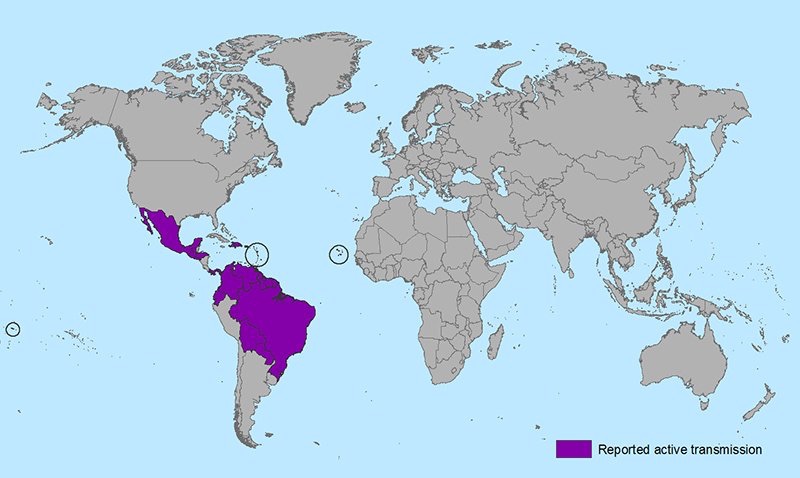
Zika Virus Countries of Origin
But what do the symptoms of Zika look like?
Generally the symptoms are vague and generic, typically mild cases of flulike symptoms and a rash. So these can include joint pains, fever, rash, conjunctivitis or there may be no specific symptoms at all. There is also a link to a more potentially severe and sometimes fatal catastrophic neurological illness, Guillain-Barre syndrome that is regarded as an autoimune disorder. This was reported in outbreaks in 2013 and 2015 in French Polynesia and Brazil. Typically most people will not know they have been infected and recover after 2-7 days without any specific treatment. The actual incubation period is unknown but is likely to be only a few days between bite and onset of symptoms.
Diagnosis is through blood sampling for virus isolation and not by serology as Zika can cross-react with other viruses such as Dengue, west Nile and Yellow Fever.
What do we know about the development history of Zika?
The Zika virus is not new even for USA and has been known about since the 1950’s and was named after the Zika forest near Lake Victoria in Uganda where it was first isolated from a captive monkey. The first human case was in 1952 in Uganda.
It has since spread across equatorial Africa and to Asia, Polynesia and South America. The first large outbreak took place in 2007 in the Pacific island nation of Micronesia and a USA subject travelling was stricken down. Essentially travelling Americans have brought the virus back to USA. It is believed that data from 50 State health departments supports that 20-30 cases of Zika have been diagnosed in USA. Reports January 28th include reported cases in Los Angeles who had travelled to El Salvador in 2015, who has since fully recovered, and a Minnesota traveller have had confirmed cases.
On January 27th 2016 the first person in Denmark tested positive for Zika. Other countries that have already registered cases include UK, Spain, Italy and Switzerland.
How to prevent Zika infections?
The biggest concern is that there is neither a cure nor a vaccine and the only known way to prevent infection is to prevent getting bitten by mosquitos using the normal routes including:
- Using DEET insect repellant
- Protective clothing
- Avoiding areas of specific large amounts of mosquitos
- Mosquito nets in an endemic area
- Empty, clean or cover water containers ( such as flower pots, buckets etc) where mosquitoes can breed
- Also an awareness that this mosquito usually bites during the morning and late afternoon/evening hours.
There have also been warnings in some Latin American and Caribbean nations for women to delay pregnancy until more is known. These countries include Colombia, Ecuador, El Salvador and Jamaica. However it has also been pointed out that widespread contraception is also not always available and abortions in some countries is illegal, making things complex to fully interpret.
The CDC advice for pregnant Americans to avoid travelling to the 20 or so countries where Zika is likely seems reasonable at the current time.
Posted in
Uncategorized and tagged
2016 brazil olympics zika,
2016 olympics,
Aedes Aegypti,
africa zika,
blood tests for zika,
brazil region,
brazil zika,
can pregnant women travel to zika areas,
can zika come to europe,
can zika come to UK,
can zika come to usa,
CDC,
CDC travel warning zika,
Centers for Disease Control and Prevention,
chikungunya,
colombia zika,
countries delay pregnancy,
culex mosquito,
delay pregnancy zika,
dengue,
Dengue, Chikungunya and Yellow Fever,
denmark,
denmark zika,
development of zika,
diagnosis zika,
ecuador zika,
el salvador,
el salvador zika,
Guillain-Barre,
Guillain-Barre brazil,
Guillain-Barre polynesia,
how diagnose zika,
how does zika spread,
how long to onset symptoms zika,
how to catch zika,
how to prevent zika,
how zika carried,
how zika named,
isa level 2 travel alert,
jamaica zika,
LA zika,
lake victoria uganda,
level two travel alert,
level two travel alert zika,
microcephaly,
microcephaly region brazil,
minnesota zika,
mosquito,
mosquito zika,
pernambuco,
pernambuco zika,
person to person zika,
polynesia,
polynesia zika,
pregnant travel,
pregnant zika,
prevent zika,
serology zika,
symptoms of zika,
uganda,
uganda zika,
USA,
virus,
virus microcephaly,
west nile disease,
what does zika cause,
what does zika do,
which countries zika,
WHO zika,
WHO Zika recommendations,
yellow fever,
zika,
zika and monkey,
zika and pregnancy,
zika blood,
zika denmark,
zika EU,
zika forest,
zika forest uganda,
zika isolated monkey,
zika italy,
zika lake victoria,
zika mosquito,
zika mosquitoes,
zika named,
zika olympics,
zika pregant women,
zika pregnant,
zika spain,
zika spread,
zika switzerland,
zika treatment,
zika uk,
zika virus
















 chris1957
 Arcticterntalk.org